Marriage Biodata Format: What to Include, What to Skip, and the Mistakes That Cost You Matches (2026)

FoldWish Team
Content & Card Specialist at Foldwish
The biodata reaches the family before you do. Here’s the complete marriage biodata format Indian families expect — section by section — plus the small mistakes (three pages, .doc files, “income: confidential”) that quietly end conversations before they start.
Here is the thing nobody says out loud about arranged marriage introductions: the biodata reaches the family before you do. Before your smile, before your achievements, before your excellent taste in restaurants — a single page, usually made in fifteen minutes in Microsoft Word, is out there representing you in living rooms you’ve never seen.
Most biodatas are bad. Not because the person is unimpressive — because the document is. Stretched photos, six fonts, three pages nobody reads, and “Hobbies: movies, music, travelling” (which describes roughly 1.4 billion people). The good news: the marriage biodata format is genuinely simple, families broadly agree on what belongs in it, and doing it properly takes about twenty minutes. This guide covers all of it.
The one-page rule
Before the sections, the single most important rule: one A4 page. Not two, not “one and a bit”. A biodata is a door-opener, not an autobiography — its only job is to earn a phone call. Aunts skim it in ninety seconds, parents compare it against three others the same evening, and nobody, in the history of arranged marriages, has read page two. If you’re overflowing, you’re not editing hard enough.
The standard marriage biodata format: four sections
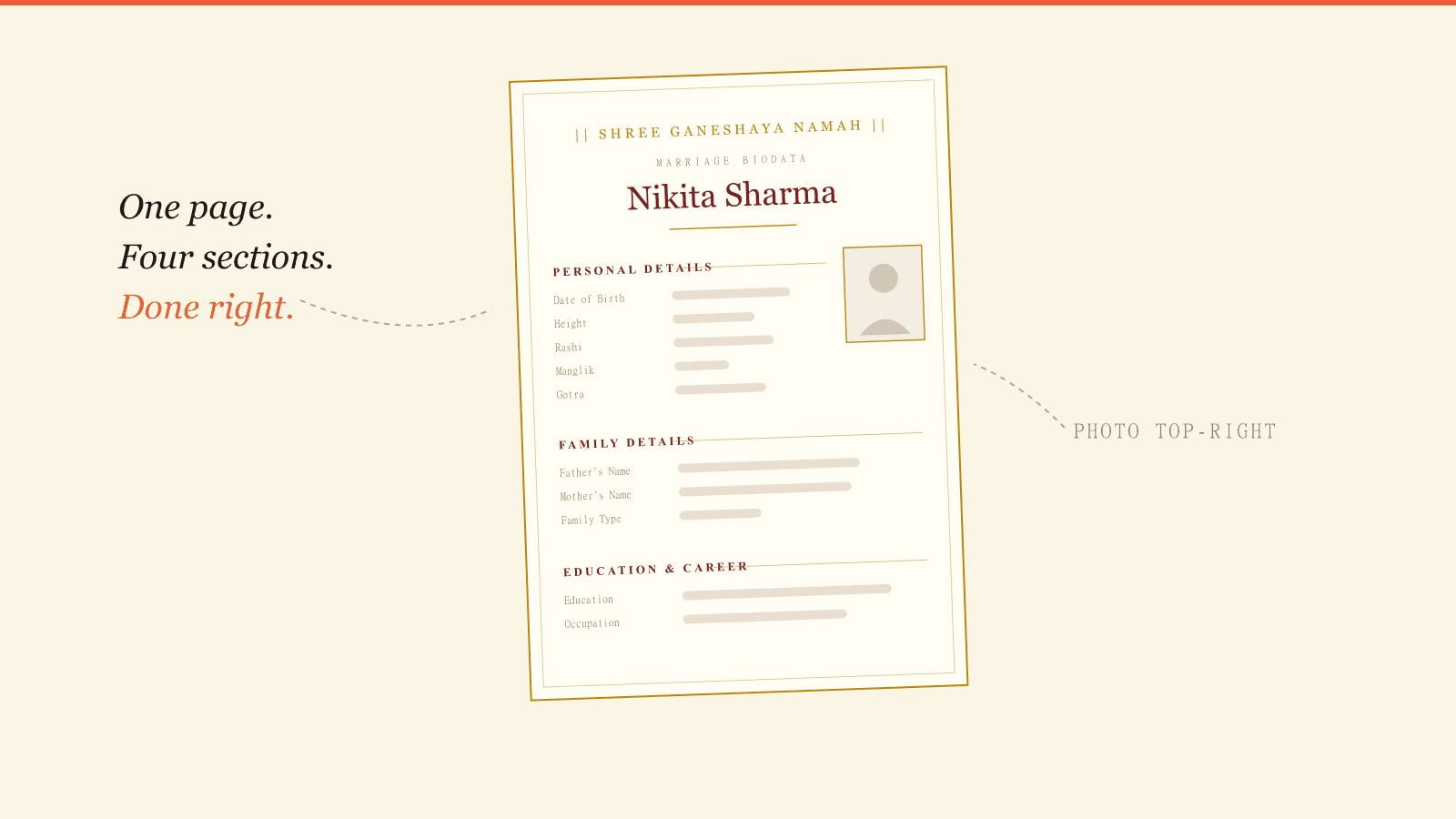
Across communities and regions, the Indian marriage biodata settles into the same skeleton: personal details (with horoscope details for families that follow them), education and career, family details, and contact information — with a photograph at the top right. Here’s each section done properly.
1. Personal details
- Full name — your complete legal name, not a nickname. In many families the middle name is the father’s name; use whatever your documents say.
- Date of birth — written the Indian way, DD/MM/YYYY (14/03/1998), and spell the month if there’s any room for confusion.
- Time and place of birth — these exist for one reason: kundali matching. If either family will match horoscopes, the panditji needs both. If nobody will, you can skip them.
- Height — in feet and inches (5'4"), which is the convention Indian families think in. 163 cm makes everyone do math.
- Rashi, nakshatra and manglik status — for Hindu families that follow astrology. Manglik deserves a clear answer: Yes, No, or Anshik (partial). Leaving it blank doesn’t avoid the question; it just guarantees a phone call about it.
- Religion, caste and gotra — state them plainly if your family observes them. Gotra matters for many Hindu communities because same-gotra matches are traditionally avoided.
- Blood group — increasingly common, and genuinely practical.
- Diet — Vegetarian, Non-vegetarian, Eggetarian, Jain. For many families this is a top-three compatibility question, so don’t bury it.
- Complexion — the most contested field on the biodata. Traditional families expect it; many modern profiles now drop it entirely. Our honest advice: it’s optional. Include it only if leaving it out would cause more conversation than putting it in.
- Hobbies — be specific or skip it. “Classical dance since age six, currently learning tabla” starts a conversation. “Music” does not.
2. Education and career
- Highest qualification with the institute — “MBA (Finance), Symbiosis Pune” carries more weight than “MBA”.
- Occupation and organisation — designation plus company: “Senior Analyst, HDFC Bank”.
- Annual income — the awkward one. Writing “Confidential” reads as a red flag; a range works better for everyone: “₹15–18 LPA”. Families aren’t auditing you, they’re gauging lifestyle compatibility.
- Work location — matters more than people think, because it quietly answers “will they need to relocate?”
3. Family details
In an arranged setting, the family section gets read as carefully as yours — often more. The convention: parents’ names with occupations (“Mr. Ramesh Sharma — Retired Government Officer” is perfectly standard), siblings with marital status (“One brother, married, software engineer in Hyderabad”), family type — joint or nuclear — and your native place. If your family is well known in a community or town, one line about that is normal and expected.
4. Contact details
Traditionally the contact person is a parent — “Mr. Rajesh Sharma (Father), +91 98290 xxxxx” — because in most families, the first phone call happens between elders. Add an email and city. You do not need to print your full home address on a document that will be forwarded across fourteen WhatsApp groups; city and area are enough.
The photo: worth more care than the text
- 1Recent means recent — within a year. The meeting should not begin with visible surprise.
- 2One clear, front-facing portrait in good light, dressed the way you’d dress for the first meeting. Top-right of the page is the conventional placement.
- 3No group photos, no cropped wedding pictures with someone’s shoulder in frame, no sunglasses, and no heavy filters — every family has a story about the photo that didn’t match the person.
Hindu, Muslim and Sikh biodata variations
The skeleton stays the same across communities; the details flex. Hindu biodatas typically carry the astrological block — rashi, nakshatra, gotra, manglik — and often open with an invocation like Shree Ganeshaya Namah or Om. Muslim biodatas skip the horoscope entirely and may mention sect and maslak where families consider it relevant, opening with Bismillah-ir-Rahman-ir-Raheem. Sikh biodatas open with Ik Onkar and generally skip astrological details. And plenty of modern families across all three skip invocations and horoscopes entirely — the right format is the one your family and community actually use, not the most traditional one available.
Marriage biodata for a girl vs a boy: is there a difference?
Structurally, none — the sections are identical, and the old asymmetries (his income described in detail, hers omitted; her complexion listed, his never) are exactly the kind of thing a modern biodata should quietly retire. List the same categories of information for either side. If she earns, say what she earns. If he cooks, hobbies is right there.
Seven mistakes that quietly end conversations
- 1Three pages. The reader stopped at one. Edit.
- 2Sending a .doc file — it renders differently on every phone and half the time opens with formatting soup. Send a PDF, always.
- 3“Income: Confidential.” Reads as either “too low to say” or “something to hide”. A range solves it.
- 4Generic hobbies. If the line could belong to anyone, it helps no one.
- 5Leaving manglik status blank in a family context where it will absolutely be asked. Answer it once, on paper.
- 6A photo that is old, filtered, or cropped out of a group. The single most complained-about biodata sin.
- 7Typos in names and dates. The document has one job: be checked by careful people. It will be.
Try it free
Make your biodata in the next ten minutes
Foldwish’s free marriage biodata maker follows this exact format — the fields Indian families expect, four elegant designs, your choice of invocation (or none), and a print-ready A4 PDF. No watermark, no signup, and nothing is uploaded: your details never leave your device.
Sharing it: the last 10% most people fumble
Export as PDF for anything formal — it looks identical on every device and prints cleanly. Keep an image version for WhatsApp, where it previews directly in the chat instead of arriving as a mystery attachment. And when a parent forwards it, a one-line message above the file (“Sharing my daughter Nikita’s biodata — we would be happy to talk further”) does what a bare attachment never will. The biodata opens the door; make sure it knocks politely.
Try it free
One page. Four sections. Done right.
Pick a traditional maroon-and-gold design or a clean modern one, fill only the fields that apply to your family, add a photo, and download. Free forever.
Tagged

Written by
FoldWish Team
Content & Card Specialist at Foldwish
FoldWish Team has spent five years helping people find the right words for the moments that matter most. We believe a well-made document — a card, an invite, a biodata — opens doors that a rushed one quietly closes.